Fear of driving or travel rarely announces itself with a dramatic scene. More often, it creeps in. A client describes a tightness at the base of the throat as they approach a roundabout. Another says they feel dizzy when lanes merge, as if the road tips sideways. One man told me the hardest part of a business trip was not the meeting in another city, but stepping onto the airport shuttle. These experiences share a pattern: the body learns to react as if danger is imminent, even when the situation is objectively safe. Anxiety hypnotherapy can shift that pattern by helping the nervous system unlearn old associations and rehearse new, calmer responses.
What driving and travel anxiety feels like
The presentations vary. Some people only feel unease on motorways. Others feel perfectly fine until crossing bridges, entering tunnels, or navigating multi-storey car parks. There may be fear of losing control, of harming others, of being trapped in traffic with no exit. The symptoms are familiar to anyone who has had panic: breath shallows, heart rate climbs, limbs feel light and distant. Vision can narrow, and it becomes hard to focus on road signs. The mind plays movies of worst-case scenarios that feel as real as the tarmac under your wheels.
Most of the time, the anxiety is learned, not logical. Maybe there was a near miss years ago, or a panic episode that happened to occur while merging. Sometimes it starts after a period of not driving, such as after an illness, or during lockdowns when road habits changed. In other cases, the fear piggybacks on life stress. A new job, a bereavement, a divorce. The human nervous system is efficient at generalisation, so once a few journeys feel unsafe, the brain begins to tag many similar situations as threats.
Why hypnotherapy fits this problem
Hypnosis is not mind control or theatrical trance. In clinic, hypnosis is a state of focused attention with reduced peripheral chatter, a place where suggestions feel vivid rather than abstract. That makes it well suited to problems that live in the body and in mental imagery, like driving anxiety. Under hypnosis, a client can experience a stretch of motorway in the mind with enough sensory detail that the nervous system responds as if it were there, but within a controlled window. In that window, we pair the trigger with a calmer physiological state and more accurate predictions. Over time, the brain updates its learning.
I use similar principles in weight loss hypnotherapy or smoking hypnotherapy, though the scripts and targets are different. The common thread is rehearsal. The brain learns what it repeats with emotion and attention. For travel fears, we rehearse lane changes, overtakes, airport queues, and the moment just before a panic wave usually crests. Clients learn to generate a cue, such as a breath pattern or a tactile anchor, before the old wave arrives. The goal is not to erase all arousal, but to change its meaning. Alertness becomes useful attention instead of a fuse that burns to panic.
What a thorough assessment looks like
Good hypnotherapy begins with detailed history. I want the first episode, the worst episode, and the most recent episode described in concrete terms. Where were you on the road when it escalated? What was your breath like during the episode? Did you feel heat or cold? What thought arrived first? Was there any alcohol or caffeine that day? How much sleep the night before?
We screen for medical contributors. Vestibular disorders, migraines, thyroid issues, and medication side effects can all mimic or worsen panic sensations. People with post-concussion symptoms may have visual motion sensitivity that turns multilane traffic into an assault. If there is a history of crashes or assaults, particularly with intrusive images, I want to know. Those cases sometimes need staged work, and EMDR therapy can be an effective partner modality when traumatic memory networks are active.
I also check for practical skill gaps. I have worked with excellent city drivers who struggle on rural roads because they never learned to judge national speed limit corners. Other clients become anxious on busy A roads because their mirror and observation skills are rusty. Confidence is not an illusion that hypnosis paints on top. It grows when mental rehearsal meets a realistic plan to upgrade skills.
Inside a typical hypnotherapy session
The structure adapts to the person, not a script. That said, there are patterns.
We start with a simple induction that pairs breath with attention. Eyes may close or remain open. The point is not sleep, it is steadying the nervous system so the mind can engage with images and sensations without flinching. I often use a brief body scan to reintroduce the idea that sensations can change within seconds. Someone who believes that once the heart races it must stay high for ten minutes learns, by direct experience, that a slow exhale can drop the rate within two or three breaths. That proof matters more than any reassurance.
Once a stable state is reached, we build a hierarchy together. For one client, the lowest rung was sitting in a parked car in the driveway with the engine on. For another, it was approaching 50 mph on a dual carriageway in the slow lane. In hypnosis, we run mental rehearsals beginning at the easy end. The practice includes sights, sounds, and tactile elements: the click of the indicator, the gentle pressure on the steering wheel, the hum of the tyres. When the old anxiety spike typically occurs, we insert the new response. A cue phrase, a five count on a longer exhale, a shift in posture that drops the shoulders while keeping arms active. I might suggest an image that aligns with the person’s work or hobbies. A violinist might imagine a slow bow that sets the pace of the exhale. A swimmer might picture gliding through water on a calm breath.

We also install anchors. An anchor is a conditioned cue that evokes a state. The most straightforward is a physical touch, such as pressing thumb and finger together after each calm rehearsal, then using that press during real driving to call up the rehearsed feeling. Anchors are not magic. Their power comes from repeated pairing. Expect two to three weeks of practice before they feel natural.
For clients whose anxiety carries a voice like a teacher or parent, parts work can help. Under hypnosis, we talk with the protective part that insists on slamming the brakes at the first hint of uncertainty. We thank it for trying to keep the system safe, then renegotiate its job with clearer rules. No braking in live traffic unless hazard lights are on ahead. No heart-in-mouth predictions unless objective speed and following distance cross the agreed threshold. That conversation sounds odd on paper, but it is surprisingly pragmatic in the room.
A brief vignette from practice
Emma, 42, had driven happily for years until a lorry drifted into her lane on a wet evening. No collision, but she yanked the wheel and felt the car wobble. After that she avoided motorways, then dual carriageways. A panic episode in a supermarket car park sealed it. She arrived certain something was wrong with her heart.
We did a medical check with her GP, which was clear. We mapped her triggers and discovered that her spikes started when she felt boxed in. The motorways felt worst near lorries and barriers. We combined two pieces of work. First, in hypnosis, detailed rehearsals of overtaking lorries while maintaining lane position. Second, practical skill-building with a driving instructor for two highway sessions focused on smooth lane changes at speed. We anchored a breath pattern to the act of checking mirrors and a cue phrase, bright and brief, that she chose: Place and pace.
Her practice included short, frequent drives, five to ten minutes, where success was measured not by distance but by using the anchor on purpose three times per drive. Within four weeks she was doing 20 minutes on an A road twice a week without panic. By week eight she had taken a fifty mile motorway trip. She still felt alert next to a lorry, but the alertness no longer tipped into fear. The change held six months later.
How many sessions, and what results to expect
For straightforward driving anxiety without major trauma history, I usually suggest a package of four to six sessions, spaced weekly or fortnightly. Some clients feel significant ease after the first or second session, particularly if they were avoiding only a small part of the driving environment. Others need ten to twelve sessions, especially if the anxiety is part of a broader pattern of panic across settings.
Hypnotherapy is not an on or off switch. Progress tends to look like greater control over early signs, shorter peaks when anxiety does rise, and the ability to reengage attention on the road sooner. If nothing changes after three sessions with honest home practice, we pause and reassess. That is when I consider adding EMDR therapy for trauma-linked material, or involve a driving instructor for targeted skills. For some, life coaching helps address the broader life load that keeps the stress system on a hair trigger.
The science and the common sense
Research on hypnosis for specific driving phobias is smaller than for pain or irritable bowel syndrome, but several lines of evidence support its use. Hypnosis reliably enhances the vividness of imagery and can modulate autonomic arousal. In practice, that means we can bring up the triggers in the mind with enough fidelity to do real work, then pair them with parasympathetic responses. Studies show hypnosis can amplify exposure therapy and cognitive techniques, likely by deepening engagement and expectancy.
Common sense matters too. The brain changes with repetition and feedback. Visualisation recruits many of the same neural circuits as doing the task. When you combine good mental rehearsal with controlled in vivo exposure, breath training, and a credible coping plan, fear has to renegotiate its role. It cannot shout the body into action the way it used to. That mix is what hypnosis orchestrates well.
Where hypnosis is not enough on its own
A small but important group needs more than hypnotherapy. People with post-traumatic stress from severe collisions may find that images intrude with a life of their own. Nightmares, startle responses, and emotional numbing can signal this. EMDR therapy can target the memory networks that hold the trauma so they integrate rather than erupt. Hypnosis can still support arousal regulation and rehearsal, but it should not be the only pillar.

There are also medical flags. Unexplained fainting, sudden visual changes, or neurological symptoms are a reason to pause and get medical input. If someone has a substance dependence that destabilises the nervous system, such as heavy alcohol use or certain stimulants, we need to address that in parallel. I sometimes work alongside colleagues who handle smoking hypnotherapy or support a reduction plan, because nicotine spikes and troughs can feel similar to anxiety and confuse the body’s signals.
For clients carrying shame or conflict around sexuality that spills into generalised anxiety, targeted sexual issues hypnotherapy can be part of a broader plan. The point is not that all roads lead to hypnosis, but that many mind-body patterns benefit when you match method to mechanism, then sequence the work wisely.
Building a real-world practice routine
Therapy hours matter, but so do the tiny repetitions woven into daily life. I ask clients to schedule two to three short drives per week, https://revibetherapy.com/services/confidence-hypnotherapy/social-confidence-hypnosis/ even during busy periods. The drive itself need not be heroic. What counts is entering with intention, using the anchor and breath practice before symptoms rise, and exiting without mental post-mortems. Short, successful loops build confidence faster than occasional long hauls that end in white-knuckle stoicism.
A simple pre-drive routine helps many clients:
- Check your body fuel: a glass of water and a small protein snack if it has been more than three hours since a meal. Choose a cue phrase that is brief and active, then say it aloud as you start the engine. Run one slow breath cycle before shifting into gear: in for a count of four, out for a count of six. Picture the first minute of the journey going well, specific and ordinary: mirrors, indicators, smooth acceleration. Set a modest target such as using your anchor three times, not a distance or destination target.
If symptoms rise during the drive, treat it like mist on the road. You do not punch mist or speed to escape it. You slow a little, orient to real cues, breathe, and allow it to thin. If needed, pull over safely. A one minute reset can save an hour of rumination.
Working with memory and meaning
Driving anxiety often carries a private logic. A client once said, If I panic in front of my kids, I will ruin their sense of safety. For another, a parent’s criticism from years earlier, You always overreact, made every flicker of anxiety feel like proof of weakness. Hypnotherapy creates room to test those meanings. In trance, we can run a micro scene where you narrate a small wave of anxiety to your child in a calm voice, then see their face stay open and interested, not frightened. Or we can replay the old criticism with your adult self stepping in, commenting, rebalancing the weight of the words. This is not about rewriting history. It is about reclaiming authority over what your body’s signals mean now.
Integrating skills from other domains
I borrow techniques from sports psychology because their athletes face performance under pressure with no option to opt out. A racing driver rehearses lines and braking points in their mind, then translates that map to the track. We do the same at an everyday scale. Before a new route, look at a map, write two or three landmarks to notice, visualise the junctions that matter. Decision points lose their sting when they are familiar.
I also use brief cognitive phrases, stripped of debate. If a client tends to spiral with what if thoughts, we practice a neutraliser, Perhaps later. Not now. Then we return to tasks that anchor attention: mirror, speed, distance. These are not affirmations, they are executive instructions. The brain respects clear jobs.
How to choose a practitioner
For driving and travel fears, ask about experience with specific phobias, panic, and trauma. Both hypnotherapists and psychologists can offer useful help. Look for someone who can explain their approach in plain language, measure progress with you, and collaborate with other professionals if needed. If they also offer adjacent services, such as EMDR therapy or life coaching, ask how and when they integrate them, not whether they simply have them on a menu.
Be wary of grand promises after a single session. Some people do change that fast, especially when the fear is recent and narrow. Many need steady work. You are looking for a guide who is honest about that and equips you to become your own therapist between sessions.
Self-hypnosis that actually gets used
Clients often ask for a home routine. A workable script is short, specific, and tied to a cue you will encounter. Here is a framework you can adapt:
Sit upright, feet on the floor, hands light on thighs. Notice three things you can see, two things you can hear, one sensation in your body. Close your eyes if comfortable. Inhale to four, exhale to six, three times. Picture your next drive, only the first two minutes. See yourself check the mirror, signal, feel the wheel steady in your hands. Whisper your cue phrase. Press thumb and finger together as you feel your exhale lengthen. Then open your eyes, look around the room, and stand slowly.
Two minutes, twice a day for two weeks, then once a day during the month that follows. Habit beats heroics.
Edge cases and what to do about them
Some people are most distressed not by fear of crashing but by fear of fainting or losing control of their bladder while driving. The shame story is as strong as the safety story. Here, we fold in elements used in treating health anxiety and social anxiety. We normalise bodily oddities, set micro experiments, and practice disclosures that reduce secrecy. For example, a client who feared needing a sudden stop for the toilet rehearsed a calm pull off, a short phrasing to a passenger, and a mental script that framed this as ordinary self care rather than catastrophe. Anxiety feeds on avoidance and secrecy. When you build scripts for what you fear, its grip softens.
Another edge case is dizziness. If the world seems to surge when you check the blind spot, get a vestibular assessment. If clear, we can practice gaze stabilisation under calm conditions. In hypnosis, you can rehearse the head turn with a stable horizon. In real life, you add small sets of gentle head turns while seated, then progress to standing, then add them to a parked car, and only then on the road. Patience prevents setbacks.
What improvement feels like from the inside
Clients often expect a eureka. More often, improvement arrives as a change in narrative speed. During a trigger, there is an extra half second before the old story rushes in. In that half second, you remember you have a choice. You use a breath, you orient to the mirror, you leave a little more distance, you say your cue. Panic may still bark, but you are already doing something useful. That is the feel of learning. It rarely looks heroic from the outside, but inside, it is a remarkable shift.
Maintaining gains
Relapse prevention is part of the work. After a period of ease, a bad day will happen. Fatigue, a head cold, or an unexpected road closure can bring a spike. Expect it and plan small. Use the anchor early. Narrate the skills you are using in a neutral tone. If you need to pull over, do it, but do not make that stop the headline of the day. The headline is that you drove, noticed, adjusted, and continued safely.
Some clients schedule a booster session every few months, particularly if life gets crowded. Others fold the skills into broader wellbeing goals. The same breath that steadies you on the motorway helps during presentations or family tensions. Skills travel.
Final thoughts from the driver’s seat
Fears around driving and travel are not moral failings, and they do not require you to become someone else. They ask for deliberate practice and a method that respects both body and mind. Anxiety hypnotherapy gives you a way to rehearse, anchor, and update the nervous system’s predictions in a structured, efficient way. When combined with sensible exposure, skills training where needed, and honest troubleshooting, it can return freedom to everyday journeys.
If you recognise yourself in these descriptions, begin with something you can complete this week. A two minute self-hypnosis practice. A ten minute drive on a familiar route with a clear anchor to use three times. If your history includes trauma or complex health factors, involve a professional who can integrate modalities, whether that is a hypnotherapist who collaborates with EMDR therapy practitioners or a team that includes life coaching support for the wider pressures in your schedule. Real progress is built from many small, specific wins. The road opens again when your body learns, through practice, that it is safe to move.
Address: 1850 Lee Rd. #122, Winter Park, FL 32789
Phone: (407) 801-2191
Website: https://revibetherapy.com/
Email: [email protected]
Hours:
Sunday: Clinician 9:00 AM - 1:00 PM
Monday: Front Desk 9:00 AM - 5:00 PM
Tuesday: Front Desk 9:00 AM - 5:00 PM; Clinician 10:00 AM - 3:00 PM
Wednesday: Front Desk 9:00 AM - 5:00 PM; Clinician 4:00 PM - 7:00 PM
Thursday: Front Desk 9:00 AM - 5:00 PM; Clinician 10:00 AM - 4:00 PM
Friday: Front Desk 9:00 AM - 5:00 PM
Saturday: Closed
Open-location code (plus code): JJ4G+5F Winter Park, Florida, USA
Map/listing URL: https://www.google.com/maps/place/Revibe+Therapy/@28.6054193,-81.3738038,17z/data=!3m1!4b1!4m6!3m5!1s0x88e771e2aaa7bacd:0xb3b93f270087b1fb!8m2!3d28.6054193!4d-81.3738038!16s%2Fg%2F11ghtgxkbv
Embed iframe:
Revibe Therapy provides hypnotherapy and related therapy services from its Winter Park office, with online therapy also available through the practice website.
The practice describes itself as a group practice specializing in Cognitive Hypnotherapy and EMDR, with service pages covering anxiety, confidence, smoking cessation, sports psychology, and other concerns.
People exploring individual therapy, couples therapy, teen therapy, sports psychology, and online support can review the service menus and location pages to see whether the practice is a fit.
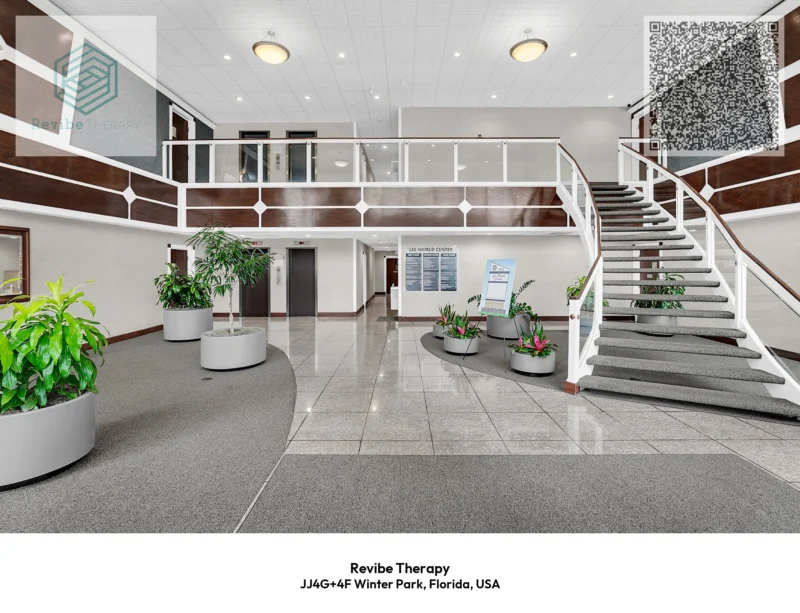
For local visitors, the Winter Park office is listed at 1850 Lee Rd. #122, Winter Park, FL 32789, placing the practice within the wider Winter Park and Orlando service area shown on the site.
The website presents a structured approach that combines mind-body methods with evidence-based psychology, which may appeal to people looking for a more focused alternative to talk-only support.
Front desk hours are listed Monday through Friday, and the Winter Park page also provides separate clinician hours on select days for local planning purposes.
To ask about availability or next steps, call (407) 801-2191 or visit https://revibetherapy.com/.
For directions and map context, the public listing for this location is https://www.google.com/maps/place/Revibe+Therapy/@28.6054193,-81.3738038,17z/data=!3m1!4b1!4m6!3m5!1s0x88e771e2aaa7bacd:0xb3b93f270087b1fb!8m2!3d28.6054193!4d-81.3738038!16s%2Fg%2F11ghtgxkbv.
Popular Questions About Revibe Therapy
What services does Revibe Therapy offer in Winter Park?
Revibe Therapy’s website lists Cognitive Hypnotherapy, EMDR, online therapy, sports psychology, individual therapy, couples therapy, teen therapy, and several topic-specific hypnotherapy services such as anxiety, confidence, smoking cessation, and related concerns.Where is the Winter Park office located?
The Winter Park office is listed at 1850 Lee Rd. #122, Winter Park, FL 32789.Does Revibe Therapy have more than one office?
Yes. The website lists Winter Park and Lake Nona locations, and it also promotes online therapy through the main site.What hours are listed for the Winter Park office?
Front desk hours are listed Monday through Friday from 9:00 AM to 5:00 PM. Separate clinician hours are listed for Sunday 9:00 AM to 1:00 PM, Tuesday 10:00 AM to 3:00 PM, Wednesday 4:00 PM to 7:00 PM, and Thursday 10:00 AM to 4:00 PM.Does Revibe Therapy accept insurance?
The Winter Park location page states that insurance is not accepted.Is online therapy available?
Yes. The site includes an online therapy section in addition to the Winter Park and Lake Nona office pages.Is hypnotherapy the only service listed on the site?
No. While hypnotherapy is a major focus, the site also lists EMDR, sports psychology, individual therapy, couples therapy, teen therapy, and online therapy.How can I contact Revibe Therapy?
Call tel:+14078012191, visit https://revibetherapy.com/, and use the public Winter Park map listing above for directions.Landmarks Near Winter Park, FL
Lee Road Corridor — The Winter Park office is directly on Lee Road, making this corridor one of the clearest local reference points for directions and nearby coverage. If you are near Lee Road and I-4, Revibe Therapy’s Winter Park page and public map listing give a straightforward starting point.Park Avenue — Park Avenue is one of Winter Park’s best-known shopping and dining districts and a useful downtown reference point for local service-area copy. If you spend time around Park Avenue, the Winter Park office is part of the same broader local area.
Central Park — This downtown Winter Park park sits on Park Avenue and regularly anchors community events. If you are near Central Park or the surrounding retail blocks, Revibe Therapy’s Winter Park location is a practical nearby reference for local therapy services.
Rollins College — Rollins College is a major Winter Park landmark at 1000 Holt Ave. If you are a student, staff member, or nearby resident, the Winter Park office provides a recognizable local option to reference online or by phone.
Mead Botanical Garden — Mead Botanical Garden is a well-known Winter Park park and nature destination. If you are coming from the Denning Drive or garden area, the practice remains within the wider Winter Park service footprint shown on the site.
Hannibal Square — Hannibal Square is a historic Winter Park district with shops, dining, and neighborhood activity close to downtown. If you are near Hannibal Square, Park Avenue, or the surrounding streets, the Winter Park office is an easy local point of reference.
Winter Park Village — Winter Park Village is a mixed-use shopping and dining destination that many local visitors recognize immediately. If you are near Winter Park Village, Revibe Therapy’s Winter Park office is part of the same practical local coverage area.
Winter Park Scenic Boat Tour — The Scenic Boat Tour is one of the city’s most familiar visitor landmarks and operates from East Morse Boulevard. If you are near the boat tour, downtown canal area, or nearby college and park districts, the Winter Park office is still a useful local reference for directions and scheduling.
Orange Avenue — Orange Avenue is one of the best-known gateway corridors between Winter Park and Orlando. If you travel the Orange Avenue corridor regularly, Revibe Therapy’s Winter Park office is positioned within that broader local access pattern.